

Application Versatility
TrueGrid®'s wide range of meshing capabilities give it the versatility needed for simulation codes of all kinds. Its adaptive meshing algorithms refine complex structures automatically, large or small, and avoids common problems with discontinuities and distortions. It handles gaps and overlays, constructs boundary layers, and uses mesh smoothing techniques when needed.
TrueGrid® 's projection method coupled with the multi-block approach, can deal as simply as possible with complex geometries - modeling objects such as turbines, pumps, jet engines, wings, and transmissions, drastically reducing the time involved.
TrueGrid® is ideal for complex models across endless industries and applications. Here are a few:
| Structures Fluid Fluid-Structure Interactions Crash Worthiness Electromagnetics | Biomechanics Hydrodynamics Heat transfer Monte Carlo Methods |
A few examples follow.
Structure and Fluid-Structure applications
The first example uses the projection method for assembling a complex structure. The second models the boundary layers for fluid flow around a complex object.
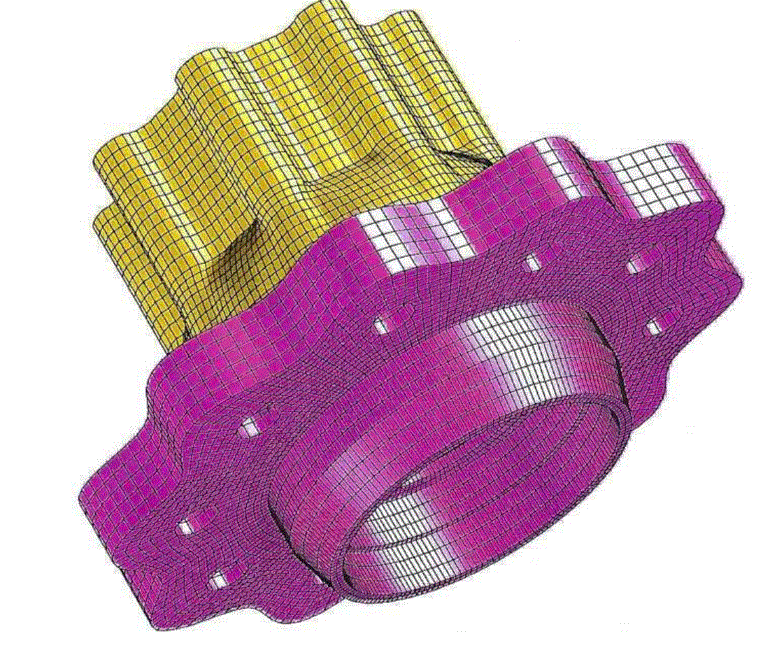
This hub was formed using two parts. Each part was formed by projecting a small portion of the mesh and then replicating those regions to form the entire part. The number of replications for each was different so careful planning was needed to make sure that the nodes at the interface between the two parts matched perfectly.
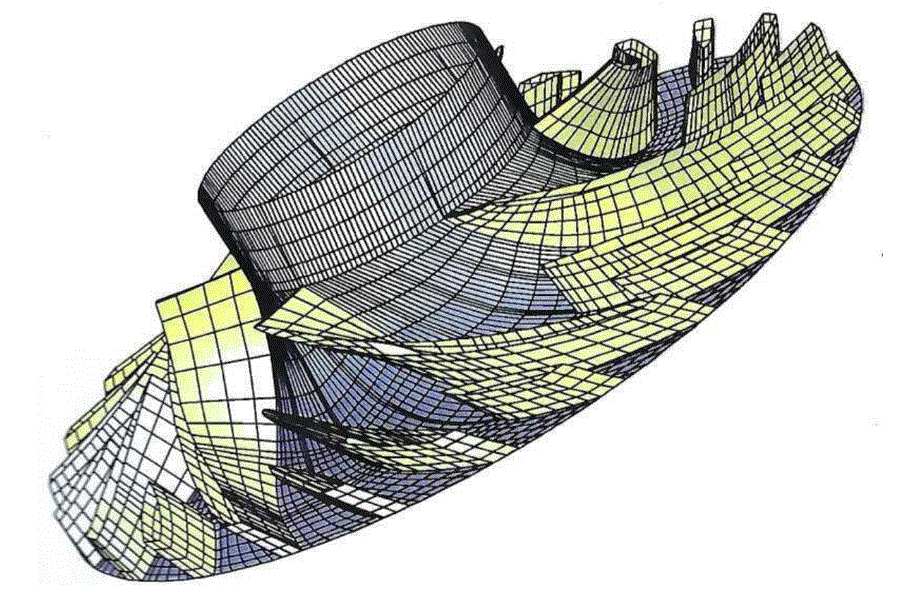
The projection method can be used to construct boundary layers for fluid flow around objects. The faces of the fluid around this impellor are shown to illustrate the nodal distribution of the fluid mesh.
Two Biomechanical applications
| In medical imaging the Marching Cubes Algorithm is used to create 3-D models of anatomical structures like bones, organs, or blood vessels from CT (Computerized Tomography) scan and MRT (MRI) data. TrueGrid® can import the STL and VP files which these imaging methods produce. Below is an all-hex mesh projected to a polygonal surface from MRI data. |
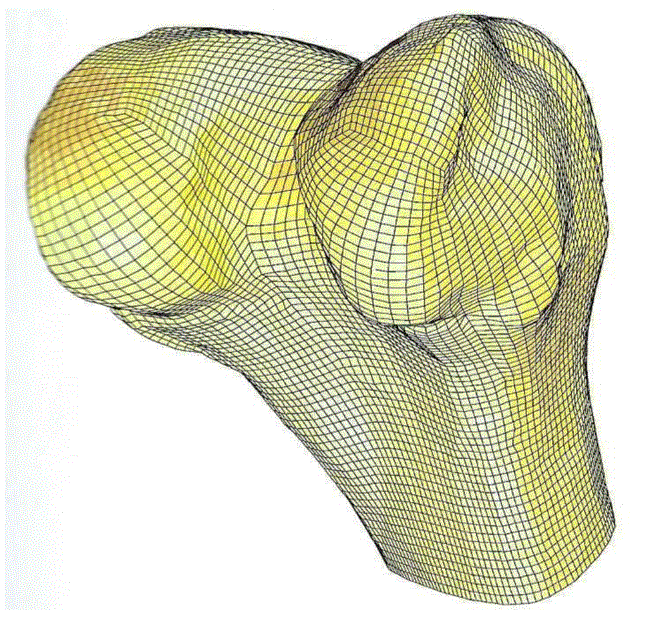
This model was constructed using a polygon surface, created from MRI measurements of a femur. The MRI data had been written in a special polygon file format. (TrueGrid® also imports STL files). The mesh is smoothed along the non-smooth surface using an elliptical smoothing algorithm while faithfully preserving the shape of the femur.
Read about how to get surface data for biological geometry.
Over the years, more than one model of the human heart has been built using TrueGrid®. This is the earliest model, dating back to the 1990s. The original data was obtained experimentally and then converted into polygonal surfaces before being read into TrueGrid®.
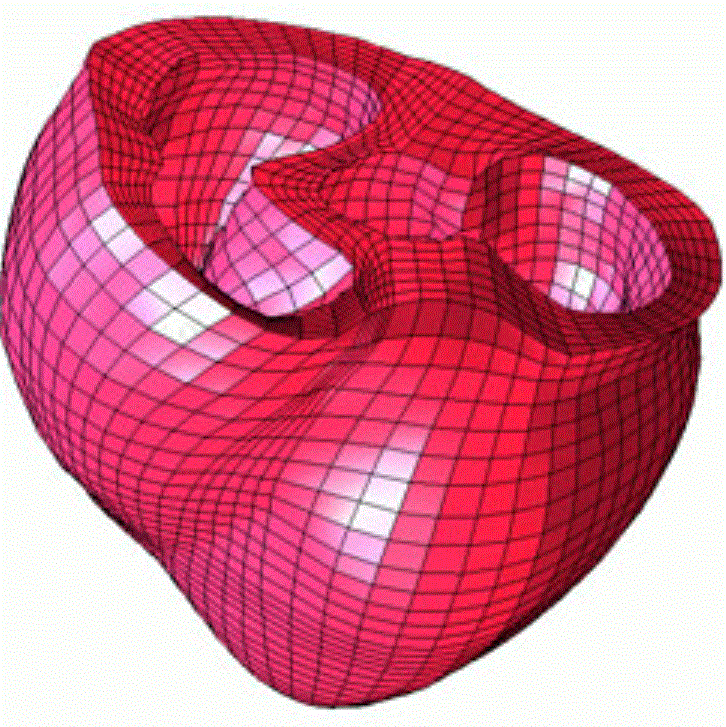
Researchers at Duke University have produced a model of portions of the human heart as they analyze the propagation of electrical current flow. Their results have been published in the on-line Journal of Circulation Research, sponsored by the American Heart Association.