

Accuracy
TrueGrid® is high-performance, automated, intelligent meshing software that produces accurate, efficient solutions. In finite element analysis (FEA), the accuracy of simulations depends heavily on the quality of the mesh, making it essential to use high-precision meshing software like TrueGrid®. TrueGrid® ensures that elements are well-shaped, properly connected, and aligned with the physics of the problem, thus reducing numerical errors and improving solution stability. A high-quality mesh leads to more accurate stress distributions, thermal gradients, and other critical engineering insights, vital for designing safe and efficient systems. Poor meshing, on the other hand, can introduce artificial distortions, reduce convergence, and compromise the validity of the results. Therefore, robust meshing software like TrueGrid® is a crucial tool for engineers and analysts seeking reliable and high-fidelity simulations.
Factors that can affect the quality of a mesh includes orthogonality, aspect ratio, warpage, shearing, and torsion. When building a mesh, you can greatly improve the quality by choosing the proper topology for the design and using smoothing algorithms to evenly distribute elements. TrueGrid® was developed with both of these issues in mind. To see why it’s important to choose the right topology, see the examples in the features section called Multi-Block Structure.
Smoothing With Elliptic Solvers
Smooth meshes are the solutions to a system of elliptic partial differential equations. The TrueGrid® equipotential relaxation method tries to equalize the zoning as it gets away from the boundary. The Thomas-Middlecoff elliptical method carries nodal distributions throughout the interior while producing near orthogonal meshes.
Nodal Density
With TrueGrid®, the user can control the distribution of nodes along edges of a block. Nodes can be equally spaced along the intersection of two surfaces forming an edge of the block.
Nodes can be clustered near one end of an edge, both ends, the middle, or distributed by a function you specify.
Diagnostics
More on diagnostics can be found in the pre-processing section.
- Warning and Error Messages inform you of omissions in the component definitions and incompatibilities in the geometry.
- Graphics and Display Visuals display node numbers, color coding local interior coordinate axis of each element, display information about the parts, size of the problem, surfaces, 2D and 3D curves, beam cross sections, joints, load curves, parameters, symmetry planes, springs and dampers, and sliding interfaces.
- Merging parts into one model serves as a diagnostic since, occasionally, the process of merging parts into a single model will reveal problems which could not be detected by looking at the parts separately. A report is issued for each merger, listing the number of nodes merged between each pair of parts. Discrepancies can reveal problems in the design of the mesh.
- Measurement commands are available to calculate the volume, mass, center of gravity, momentum, moments of inertia, products of inertia, and products of inertia for all parts and materials of the model or any subset thereof.
- Commands to calculate the volume, mass, center of gravity, momentum, moments of inertia, and products of inertia.
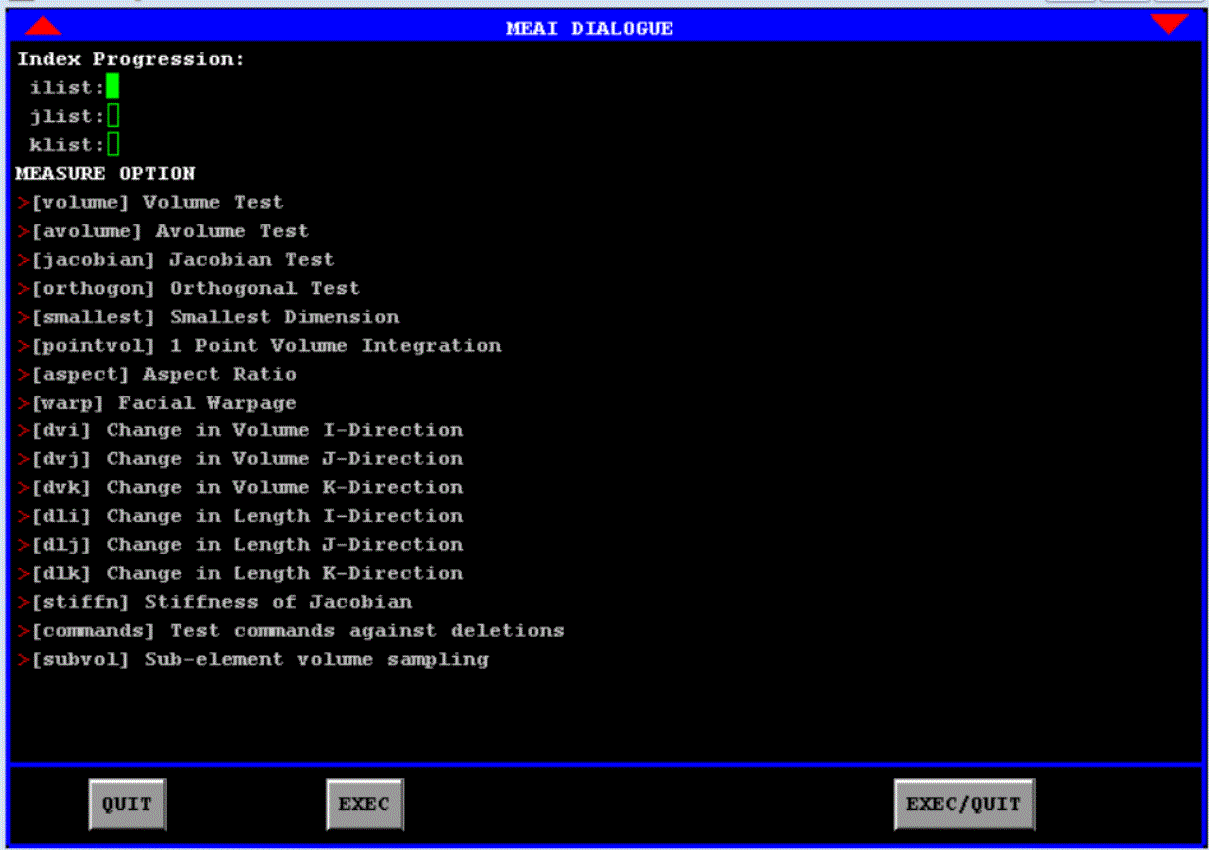
One of the Measure Dialogue boxes that lists tests a user can run on their mesh:
Verification and Validation
We have run numerous parametric FEA models and applied numerical methods of verification and validation of the computer simulations. We have varied the mesh density, element type, and simulation platform. Other tests were to ensure that small changes to geometry cause only small changes in the mesh density. This is important because if a small change in the geometry were to cause a radical change in the mesh, then the mesh itself might cause substantial variations in the simulation results. This is a strong argument for TrueGrid® 's multi-block structured meshes where the mesh topology is prescribed. It is potentially a problem with those automatic mesh generators that can undergo a radical change in the mesh topology when a small change is made to the geometry.